
Historic Directory Collections in Bay City
Bay City has an unusually long local directory trail, but its pieces are not all in one place. The Bay County Library System makes a searchable directory database available for 1873 through 1946, with selected entries from Essexville, Saginaw, and Salzburg. The Bay County Historical Society's Butterfield Memorial Research Library reports Polk directories reaching to 1866. Brown's 1871 directory, early Polk issues, and a West Bay City run add useful bridges around the main library database. Treat a gap between issues as a gap in the source, not proof that a household left town.
| Collection | Years | Where Held | Access |
|---|---|---|---|
| Library directory database | 1873-1946 | Bay County Library System | Searchable library database |
| R. L. Polk & Co. runs | 1871-72 through 1946, with located gaps | Library, Historical Society, and partner scans | Name, street, and classified sections vary by issue |
| Butterfield Polk holding | To 1866 | Bay County Historical Society | On-site or written research request |
| West Bay City volumes | 1889-90, 1890-91, 1896 | Local finding aids and genealogy scans | Predecessor-place bridge |
The earliest directory material also includes an 1868-69 volume for Bay City, Portsmouth, Wenona, and Bangor. That wider geography explains why a strict modern-city search can miss an otherwise sound match. The collection dates are coverage clues, not a promise that every volume is digitized or that every resident appeared in print.
Library Directory Shelf, Bay City
The local-history and genealogy room at Wirt Library, 500 Center Avenue, is the practical starting shelf for many local directory searches. Its genealogy database page identifies the searchable volumes, and the library also provides Ancestry Library Edition for use at the library. That resource includes census, vital, church, court, and immigration material that can help distinguish a same-name entry. Wirt is the system's largest reference collection, so it is a better first stop than assuming every historical volume is on the open web.
See the Bay County Library genealogy databases before a visit or a remote inquiry. The page places the local database alongside other local-history tools, making it easier to plan a surname search and then test it against a census or vital record. Library access and outside databases do not turn a historical listing into present-day confirmation.
Library access details appear on the Bay County Library genealogy databases page.
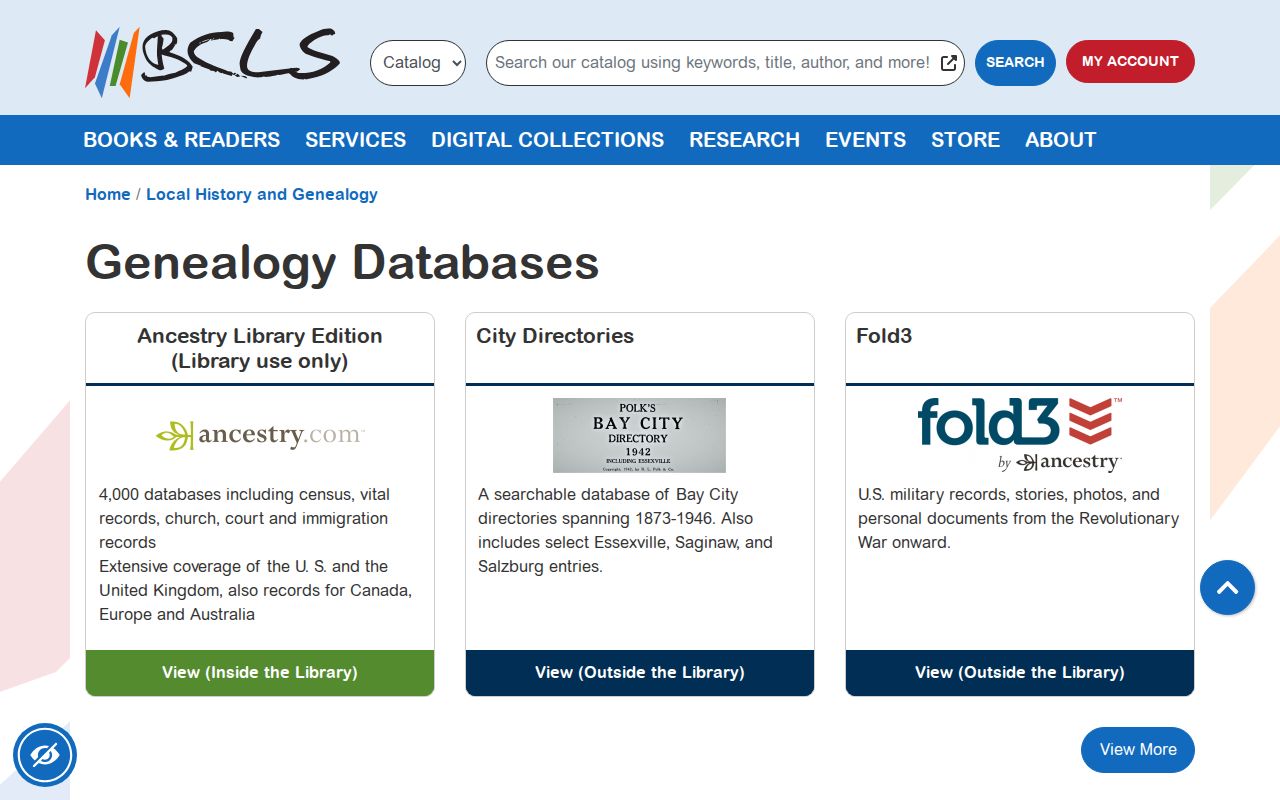
The library database is a useful entry point for the local run, while the local-history room supplies the research setting for related sources.
Note: A library catalog or database result identifies a likely source, but the year and the original entry still need to be read in context.
Digital Directory Collection in Bay City
The library's Digital Collections page brings together digitized local directories and Bay City Times Historical Newspapers. The two collections work well as companions. A directory gives a yearly placement of a name or address, while a newspaper search can supply an obituary, marriage notice, memorial, business notice, or civic item to test the timing. The library landing page does not publish a complete date range for the newspaper collection, so a missing search result should not be treated as a complete negative.
The library's Digital Collections page lists the digitized directory and newspaper routes.
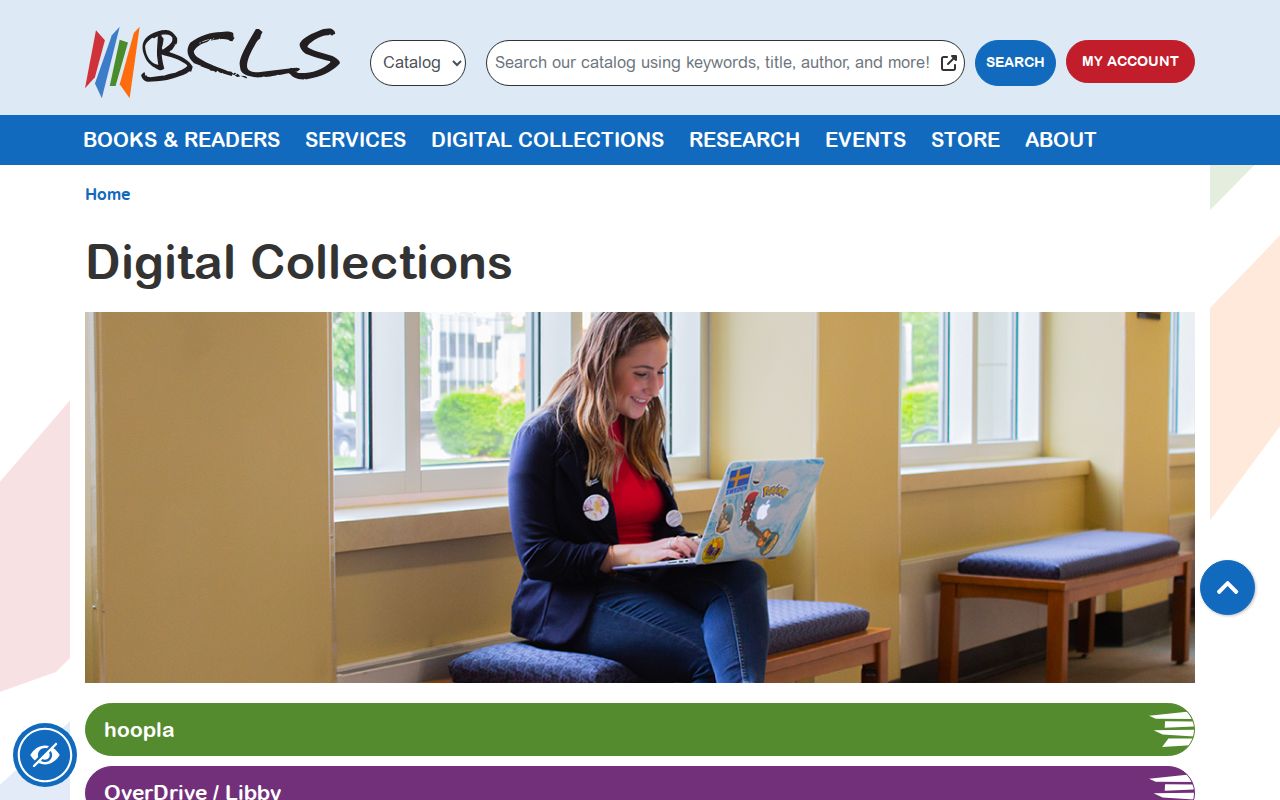
Digitized local volumes sit beside historical newspaper resources, which can help confirm a name, date, or address change.
Use the original page or image when possible. Transcriptions and search results can omit punctuation, initials, or the column that makes an abbreviated entry understandable.
Reading a Directory Entry in Bay City
The transcribed 1905-06 R. L. Polk & Co. volume is a clear example of how a historical entry is built. Its city rows use last name, first name, occupation, residence, and comments. One visible row lists Alfred F. Adams, marked "lab," at 906 Polk. That notation captures a historical residence and occupation entry, not a current assertion and not a complete household profile. The abbreviation key is essential because short forms carry much of the volume's meaning.
| Name | Usually the surname and given name used by the directory, which may appear as initials. |
|---|---|
| Occupation | A compact work description, often abbreviated, such as lab for laborer or mach for machinist. |
| Residence | The street address or residence notation printed for that annual issue. |
| Comments | An additional column when the issue supplies one; it can be blank in a visible row. |
| Abbreviation key | Terms such as res, av, rd, n, and s explain the short forms. |
- Householder index
- A name-first portion of a directory that helps locate a person or household entry.
- Criss-cross directory
- A later address-first directory arranged by street and number, usually centered on heads of household.
- Abbreviation key
- The printed guide to compressed street, occupation, and location terms, often near the front of the volume.
County entries in the 1905-06 volume follow another pattern: business, section number, acreage, assessed valuation, township, and post-office address. Do not read that county-farm metadata as if it were a simple Bay City street listing.
Polk Directory Years in Bay City
Polk is the central local directory name, but the run is a sequence of known issues rather than a seamless annual file. Located issues include 1871-72, 1881-82, 1886-87, 1890-91, 1897, 1902-03, 1905-06, 1906, 1908 through 1911, 1913, 1914-15, 1916, 1920, 1922, 1924, 1926, 1929, 1931, 1935, 1937, 1938, 1940, 1942, 1944, and 1946. The Historical Society's holding reaching 1866 and the library database spanning 1873-1946 form two different but complementary coverage layers.
The 1860 Michigan Gazetteer, 1863-64 state gazetteer, 1866-67 pioneer material, the 1868-69 directory, Brown's 1871, and Polk from 1871-72 onward create a deeper local sequence. That long shelf is a records story in itself: Lower Saginaw became Bay City by legislative enactment in 1857, and the early publications retain names that later sources may compress or replace.
The 1905-06 Polk directory transcription displays the period's fields and abbreviation key.
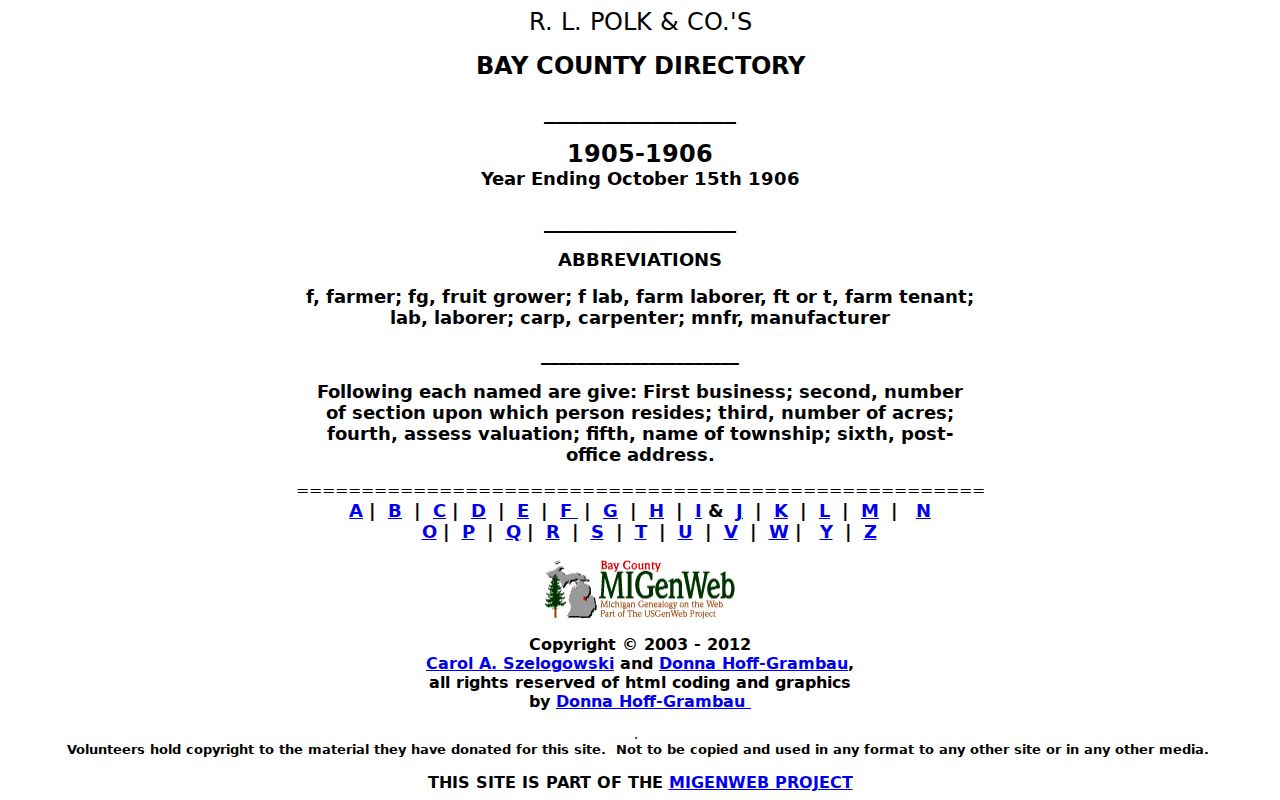
This example shows why initials, occupation abbreviations, and address format should be copied carefully before searching another year.
Note: A gap between two available Polk years calls for a nearby issue, census schedule, deed record, or newspaper search rather than a guess about what happened.
Criss-Cross Directory Limits, Bay City
The Library of Michigan describes Bresser and criss-cross directories as a later layer, generally beginning in the late 1960s. Their street sections arrange streets alphabetically and house numbers in order. They can show a head of household, telephone number, owner or renter notation, first-listed year, new-arrival clues, and moves. Phone sections can connect a listed household or business to an address. That makes the format helpful when an address comes first, but the exact Bay City Bresser run was not located.
For that reason, do not assign a specific Bresser year range to Bay City. Ask Wirt or the Library of Michigan about the actual volume needed, then use the street section with the name section. Polk offers richer named-household and occupation detail in the older period, while the later criss-cross form is an address-first tool with its own limits.
Directory Place Names in Bay City
Historic search terms need more than "Bay City." Directory material includes Lower Saginaw, West Bay City, Wenona, Portsmouth, and Salzburg. West Bay City has its own located 1889-90, 1890-91, and 1896 directories. The Bay County Library database also includes selected Essexville, Saginaw, and Salzburg entries. Search each relevant name, then compare the street and year instead of assuming a modern boundary or postal label applied at the time.
Bay City's river, lumber, milling, shipbuilding, and historic-architecture setting can help put an address in a development era, but it cannot identify a person by itself. The City Master Plan and historic-preservation material provide context for downtown, Midland Street, Center Avenue, and the older west-side Sage area. A directory address is strongest when paired with the volume date and another record.
Tracing Directory Families in Bay City
Follow one local directory entry forward and backward through the nearest available issues. Record the spelling, initials, occupation, address, and any household reference exactly as printed. Then compare a directory year with the closest released federal census, which is available through 1950 under the 72-year rule. Census schedules add household composition, age, birthplace, and relationships, while directories supply the useful years between those federal snapshots.
- Find the surname in a known directory year and copy the entry, including abbreviations.
- Check the nearest available earlier and later issues for a move, new spelling, spouse clue, or changed occupation.
- Read the street section when present to place the entry at the correct house number and view nearby listings.
- Pair the address and name with the nearest 1900, 1910, 1920, 1930, 1940, or 1950 census schedule.
- Use the Bay City Times collection, an obituary, deed record, or vital record to resolve a disappearance from the directory.
A disappearance can mean a move, a death, a name variation, or simply nonappearance in that issue. Search a spouse, initials, occupation, street section, classified section, and predecessor place name before reaching a conclusion. The historical volumes themselves are useful for the household layer; modern address-keyed records belong with the Bay City Street Directory.
Directory Addresses in Bay City
Directories name people and addresses. Maps help establish what stood at that address. The Library of Congress catalog identifies Bay City Sanborn material for 1895, 1912 volumes one and two, 1922, and 1950. The Historical Society also reports Bay City insurance maps spanning the 1890s to the 1960s, plus bird's-eye views from 1867, 1879, and 1891. These sources can show building footprint, use, material, stories, and neighborhood change.
| 1895 | Bay City Sanborn catalog material, including seven sheets. |
|---|---|
| 1912 | Two Bay City volumes, cataloged as 117 and 78 sheets. |
| 1922 | A Bay City catalog item, useful for a dated address comparison. |
| 1950 | Later Bay City Sanborn catalog volumes. |
Not every catalog item is online. The Library of Congress Sanborn catalog record is a good starting point for locating the materials, while Wirt and Butterfield can help with local map context. Maps date structures, not residency.
Bay City Records Beyond Directories
When a directory entry points to a civic project or public official, the University of Michigan Bentley finding aid holds Bay City government records from 1898 to 1933. The collection contains correspondence associated with the mayor, city attorney, city manager, and city engineer. It can place a public project or officeholder in time, but it is not a general name directory. The Historical Society's county histories, architecture files, and local-business material offer other context when the question is about a building, family, or neighborhood history.
The strongest local directory work moves from one dated source to another without overstating what any single annual volume proves. Copy the entry, identify its geography, compare a nearby year, and let the library, archive, map, census, or deed record answer the next narrow question.