
Past-Household Records in Bay City
A backward search needs sources that overlap. Bay County's recorded-document tools can establish a chain of title, while directories and census schedules can place households at an address. Sanborn maps describe a structure and its setting rather than its occupants. The Bay City trail has clear limits: the Register of Deeds card index is labeled 1958-1984, the library database spans 1873-1946, and the exact continuous start year of the modern online deed index was not located. Match the question to the era, then keep the results separate until the address and dates agree.
| Source | Years It Covers | Where Held | What It Shows |
|---|---|---|---|
| Deed and card index | Card index 1958-1984; modern coverage not given as one continuous start year | Register of Deeds, Doxpop/Landmark, counter | Transfers, encumbrances, and legal description |
| Polk directories | Historical Society holding to 1866; library search 1873-1946 | Wirt, Historical Society, partner scans | Named household, address, occupation, and business clues |
| Bresser or criss-cross | Late 1960s onward generally; Bay City run not located | Library or Library of Michigan | Address-first heads of household and movement notes |
| Federal census | 1900-1950 useful locally | NARA and library databases | Household composition and address geography |
| Sanborn maps | 1895, 1912, 1922, 1950; society maps 1890s-1960 | Library of Congress, library, society | Building footprint, use, material, and change |
Start with the current parcel when the aim is an ownership trail. Start with a dated directory or census when the question is about a household in a known era. A city permit, Bay City Times notice, obituary, or probate file can help close a gap, but the research did not identify a searchable historic permit range or a complete published newspaper date run.
Bay City Parcel Records Before Backtracking
Before looking for earlier occupants, preserve the current parcel identity. In Bay County FetchGIS, record the PIN, property or situs address, owner name, owner mailing address, and legal or tax description. The situs address is where the land and building sit. The mailing address is where tax notices go. It may be a post-office box, a business, a trustee, or another location, so it does not establish who occupied the Bay City address.
FetchGIS supports a street address, owner name, 14-digit PIN, intersection, coordinate, and map search. Street lookup can be sensitive to spelling and case. If a search fails, try the street without a unit, a different directional form, a PIN, or a map click. The viewer is informational and not a legal survey or the official county record, so keep its report as a working lead and verify the deed and parcel data with the proper county source.
- PIN
- The parcel identification number. Bay County training describes a 14-digit parcel number.
- Situs address
- The physical location of the parcel, which anchors an address-history search.
- Legal description
- The lot, block, subdivision, survey, or other land description used to distinguish property in records.
Note: Preserve the legal description with the street address, because street numbers, place names, and parcel configurations can change over time.
Deed Records Back Through Bay City
The Register of Deeds trail begins with the current owner and legal description, not a name-only search. Use the Bay County Landmark Web index or the county-linked Doxpop route to search the current owner as a grantee, the party who received the property. Read the acquisition instrument for its grantor, the party who transferred the property. Then search that grantor as a grantee to find the earlier acquisition. Check the legal description, subdivision or lot and block, document date, and identifier at each turn.
- Save the current PIN, situs address, owner name, and legal description from the parcel report.
- Search the current owner as grantee and narrow by date or document category when necessary.
- Read the acquisition deed and copy the seller or grantor, recording date, and document identifier.
- Search that grantor as a grantee to identify the prior purchase, then compare the legal description again.
- Repeat the loop, using plats, subdivision material, deed books, ledgers, or microfilm when the web index does not reach the needed record.
- Grantor
- The party transferring an interest in the property.
- Grantee
- The party receiving an interest in the property.
- Chain of title
- The sequence of recorded transfers connecting one owner to earlier owners.
Bay City has repeat surnames and business entities, so a matching name alone is not enough. An estate, trust, corporation, spouse, or variant spelling can enter the chain. The legal description is the best safeguard against joining records for different parcels.
Bay City Deed Cards and Citation Changes
Bay County maintains a separate online card-index search labeled 1958-1984. It is not interchangeable with the modern recorded-document search. The county also states that documents recorded from January 1, 2018 use a Document Number rather than Liber and Page. Older deeds may therefore be cited by Liber and Page while later deeds use a document number. Copy both forms exactly when they appear in a chain, rather than assuming a search form will accept only one citation style.
The county's 1958-1984 Register of Deeds card-index search identifies this separate historical layer.
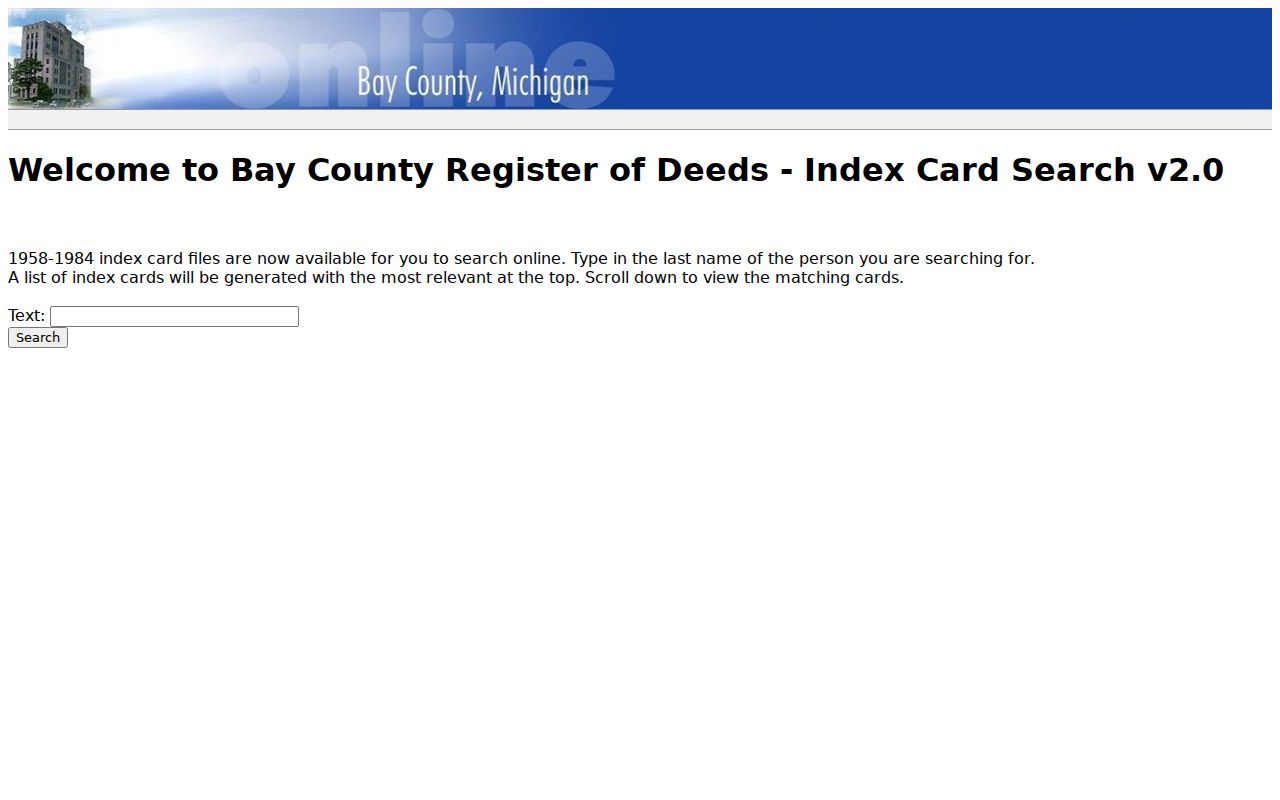
The Bay County card index can supply a bridge in a previous-residents search when an address history crosses the 1958-1984 period.
The Register of Deeds research counter is open weekdays from 8:00 a.m. to 4:30 p.m. and remains open through lunch; the public office hours run to 5:00 p.m. Ask the counter for the specific deed book, grantor-grantee ledger, plat, or microfilm record needed. A focused request works better than asking an office to reconstruct an open-ended house history.
Earlier Bay City Records Before 1958
The 1958-1984 cards do not establish a complete earlier online trail. In December 2025, the Bay County Board approved a three-year Common Chain and CSI project for AI-assisted extraction of archived records. The resolution describes a goal of accurately indexing archived documents back to 1857 and extracting more than 40 data points. That is a current project target, not evidence that every pre-1958 deed is already searchable online.
For the earlier part of a chain, use the Register of Deeds counter and ask for deed books, grantor-grantee ledgers, plats, and microfilm. Michigan Archives county guides and the Historical Society are additional routes for older county and local history material. Keep a record of the search date and the exact book, page, or document number used, because index coverage and online display can change.
Note: The county's records history did not identify one verified continuous online start year for every deed type, so do not treat a no-result as proof that no earlier record exists.
Bay City House History at Wirt
Bay County Library publishes Researching Your House History and Research Sources for Old Homes. These materials point toward directories, deeds, atlases, and Sanborn resources that can place an address in sequence. Wirt Library's local-history and genealogy room at 500 Center Avenue is the library setting for those related collections. It is useful after the parcel and deed work has fixed the right property identity.
The Bay County Historical Society's Butterfield Memorial Research Library at 321 Washington Avenue accepts written house or ancestor research requests by email or mail. Its request guidance calls for details such as the address, ancestor name, spouse, parents, death information, residence, and sources already checked. The stated research fee is $20 per hour, copies are $0.25 each, and requests generally take three to four weeks in received order. Its public hours were marked temporarily closed when inspected, so call or email before travel.
That request process is best for a specific address, family, and time period. It may draw on Polk directories, county histories, genealogical material, local business files, architecture material, and maps, but the society states that the fee is due even when no information is found.
Bay City Household Records in Directories
Ownership is only one part of an address history. For earlier households, pair a dated Bay City directory with the nearest federal census. The library's searchable directory database spans 1873-1946, and the Historical Society reports Polk holdings to 1866. The Library of Michigan describes later Bresser and criss-cross volumes as address-first tools, generally from the late 1960s onward, but the exact Bay City run was not located. The historical collections are described in more detail on the Bay City City Directory page.
Use a short, repeatable flow: directory year and address, then nearest census, then a newspaper, obituary, probate file, or deed if the household changes. The census schedules from 1900 through 1950 are useful local checkpoints and give household relationships, age, birthplace, and occupation. A directory can provide a street and annual placement between census years. Neither source alone proves a full uninterrupted period of residence.
- Choose a directory year near the transfer or building event already identified.
- Search the surname section and street section, copying initials, address form, and occupation notation.
- Compare the closest census schedule for household relationships and address geography.
- Check the Bay City Times collection for an obituary, marriage or death notice, memorial, or community item.
- Return to the deed chain or Probate Court when a death or estate transfer creates the next ownership change.
Bay City Address Records on Maps
When a street number does not carry cleanly backward, turn to the legal description, plat, map, and historical place name. The Library of Congress catalog records Bay City Sanborn material for 1895, 1912, 1922, and 1950. The Historical Society reports insurance maps from the 1890s to the 1960s. They can show footprint, material, use, stories, and building change, but not a resident roster. The research did not find a verified citywide street-renumbering or renaming date, so do not invent one to force a match.
Search Lower Saginaw, Bay City, West Bay City, Wenona, Portsmouth, and Salzburg where the period warrants it. Lower Saginaw became Bay City in 1857, and historical directory coverage includes those predecessor names. A vanished street listing may reflect a changed locality name, an absorbed place, a different address format, or a missing directory year rather than a vanished household.
The Library of Congress Bay City Sanborn record is a locating tool for map material. Compare its date with the directory and deed dates, then use local library or Historical Society material when a physical or non-digitized map is needed.
Bay City Record Trail Endpoints
A deed chain may end with a death, estate, or transfer through an heir. At that point, check the Bay City Times digitized collection, cemetery leads, and the Bay County Probate route. Probate filings can identify a decedent, personal representative, heirs, estate property, and sometimes mailing details, subject to redaction or sealing. Court files are requested from the court, not through a county administrative FOIA request. A death record that is at least 75 years old may be eligible for Michigan genealogical release, subject to the state's rules.
Use each endpoint to test the property trail, not to turn a name into a conclusion. An obituary may name relatives but omit an address. A probate file may identify heirs but not explain every deed. A newspaper hit can set a date but needs the original context. The most reliable Bay City history keeps the parcel, legal description, directory year, map date, and household evidence aligned.